









Introduction: Extreme Cold as a Culinary Tool
Liquid nitrogen cooking represents one of the most fascinating and transformative developments in modern gastronomy. Once limited to scientific laboratories, industrial processes, and medical preservation, liquid nitrogen has gradually entered the culinary world, reshaping how chefs think about temperature, texture, and sensory experience. At an astonishing temperature of –196°C (–321°F), liquid nitrogen enables instant freezing, dramatic visual effects, and unprecedented control over food structure.
Unlike conventional cooking methods that rely on heat to transform ingredients, liquid nitrogen cooking explores the opposite extreme: intense cold. This reversal challenges traditional culinary paradigms and expands the creative vocabulary of chefs. From ultra-smooth ice creams and brittle frozen fruits to vapor-filled presentations that engage sight and smell, liquid nitrogen has become a defining symbol of molecular gastronomy and culinary innovation.
This article offers a comprehensive, professional, and in-depth examination of liquid nitrogen cooking. It explores the scientific principles behind it, its historical development, key culinary techniques, applications across different types of cuisine, safety considerations, cultural influence, ethical and environmental aspects, and its future role in the global food industry.
1. What Is Liquid Nitrogen? Scientific Foundations
1.1 Physical and Chemical Properties
Nitrogen is a naturally occurring element and the most abundant gas in Earth’s atmosphere, accounting for approximately 78% of the air we breathe. Under normal conditions, nitrogen exists as a colorless, odorless, and inert gas. When cooled to extremely low temperatures, it condenses into a liquid state known as liquid nitrogen.
Key characteristics of liquid nitrogen include:
- Boiling point: –196°C (–321°F)
- Non-toxic and chemically inert
- Rapid evaporation at room temperature
- Extremely high cooling capacity
These properties make liquid nitrogen uniquely suitable for culinary use. Because it does not chemically react with food, its effects are purely physical, altering texture and temperature without introducing foreign flavors or compounds.
1.2 Rapid Freezing and Ice Crystal Formation
The defining advantage of liquid nitrogen in cooking is its ability to freeze food almost instantaneously. Traditional freezing methods operate slowly, allowing large ice crystals to form within food. These crystals rupture cell walls, leading to textural degradation and moisture loss upon thawing.
Liquid nitrogen, by contrast, freezes water so rapidly that ice crystals remain extremely small. This preserves cellular structure, resulting in superior texture, enhanced flavor retention, and improved visual appeal. This principle underpins nearly every culinary application of liquid nitrogen.
2. Historical Development of Liquid Nitrogen in Cuisine
2.1 From Industry to Gastronomy
Liquid nitrogen was first produced on a large scale in the late 19th and early 20th centuries, primarily for industrial and scientific purposes. Its applications included cryogenics, metallurgy, food preservation, and medical research. For decades, its use in cooking was virtually nonexistent, largely due to safety concerns and limited accessibility.
2.2 Emergence in Molecular Gastronomy
The culinary adoption of liquid nitrogen began in the late 20th century alongside the rise of molecular gastronomy. Visionary chefs sought to apply scientific principles to cooking, exploring how temperature, pressure, and chemical reactions influence food.
Pioneering figures such as Ferran Adrià, Heston Blumenthal, and Grant Achatz introduced liquid nitrogen into high-end restaurants. Their work demonstrated that extreme cold could be as expressive as heat, opening new dimensions of creativity and redefining fine dining.
2.3 Expansion into Mainstream Culinary Culture
Over time, liquid nitrogen moved beyond elite restaurants into culinary schools, experimental kitchens, and eventually selected commercial food outlets. Nitrogen ice cream shops, molecular cocktail bars, and televised cooking competitions helped popularize the technique, transforming it into a recognizable symbol of modern gastronomy.
3. Liquid Nitrogen and Molecular Gastronomy
3.1 Defining Molecular Gastronomy
Molecular gastronomy is a scientific discipline that studies the physical and chemical transformations of ingredients during cooking. It does not replace traditional cuisine but seeks to understand and enhance it through experimentation and precision.
Liquid nitrogen plays a central role in this field by offering unparalleled temperature control. It allows chefs to manipulate texture, structure, and sensory perception in ways previously impossible.
3.2 Science as a Creative Partner
In molecular gastronomy, science is not an end in itself but a creative partner. Liquid nitrogen exemplifies this philosophy: it is both a technical tool and an artistic medium. Its dramatic vapor, instant transformations, and textural possibilities engage diners intellectually and emotionally, making the act of eating a multisensory experience.
4. Core Techniques in Liquid Nitrogen Cooking
4.1 Flash-Freezing
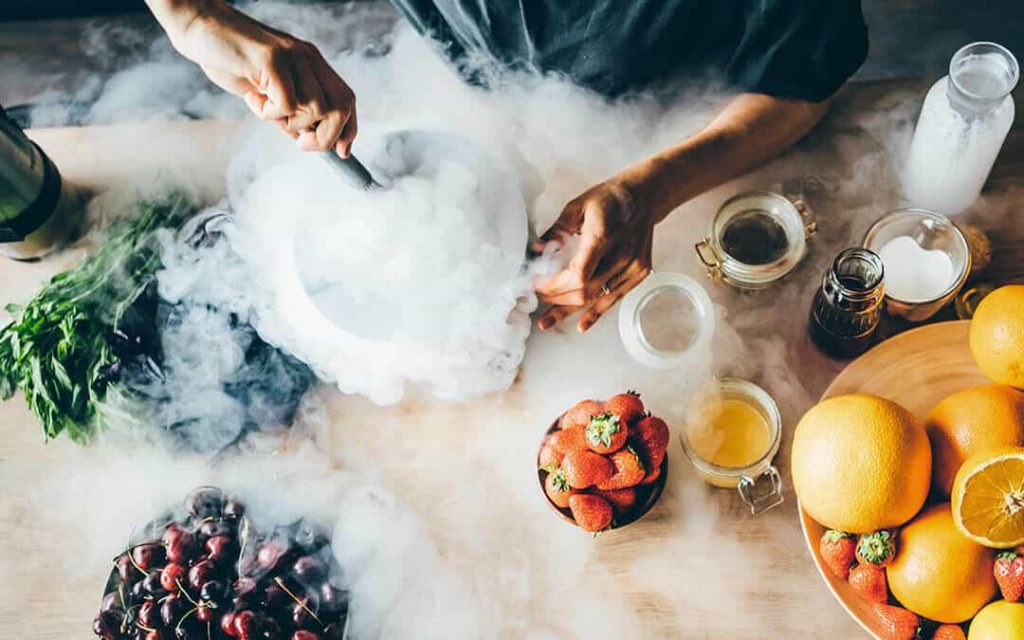
Flash-freezing is the most fundamental technique involving liquid nitrogen. Ingredients are either submerged in or exposed to liquid nitrogen, freezing them instantly.
Applications include:
- Ice cream and sorbet
- Fruits and vegetables
- Herbs and aromatic components
- Delicate proteins for precise slicing
The result is exceptional texture, minimal moisture loss, and enhanced flavor clarity.
4.2 Instant Ice Cream Production
One of the most iconic uses of liquid nitrogen is the creation of instant ice cream. A liquid base—typically containing cream, sugar, and flavoring—is stirred while liquid nitrogen is slowly added. Within seconds, the mixture freezes into a smooth, creamy dessert.
Advantages over traditional ice cream methods:
- Extremely small ice crystals
- No need for aging or long churning
- Immediate service
- Superior mouthfeel and flavor intensity
This technique has become both a culinary innovation and a form of entertainment.
4.3 Textural Transformation and Powderization
Liquid nitrogen enables chefs to alter textures dramatically. Soft ingredients can become brittle solids, which can then be crushed or ground into powders.
Examples include:
- Frozen olive oil powder
- Nitrogen-crisped herbs
- Shattered frozen fruits used as garnishes
These textures create contrast and complexity, enriching the overall dining experience.
4.4 Thermal Contrast and Multi-Temperature Dishes
Liquid nitrogen allows chefs to incorporate extreme temperature contrasts within a single dish. A plate might feature a frozen element alongside warm or hot components, challenging conventional expectations of temperature consistency.
This technique enhances sensory engagement and encourages diners to experience food more consciously.
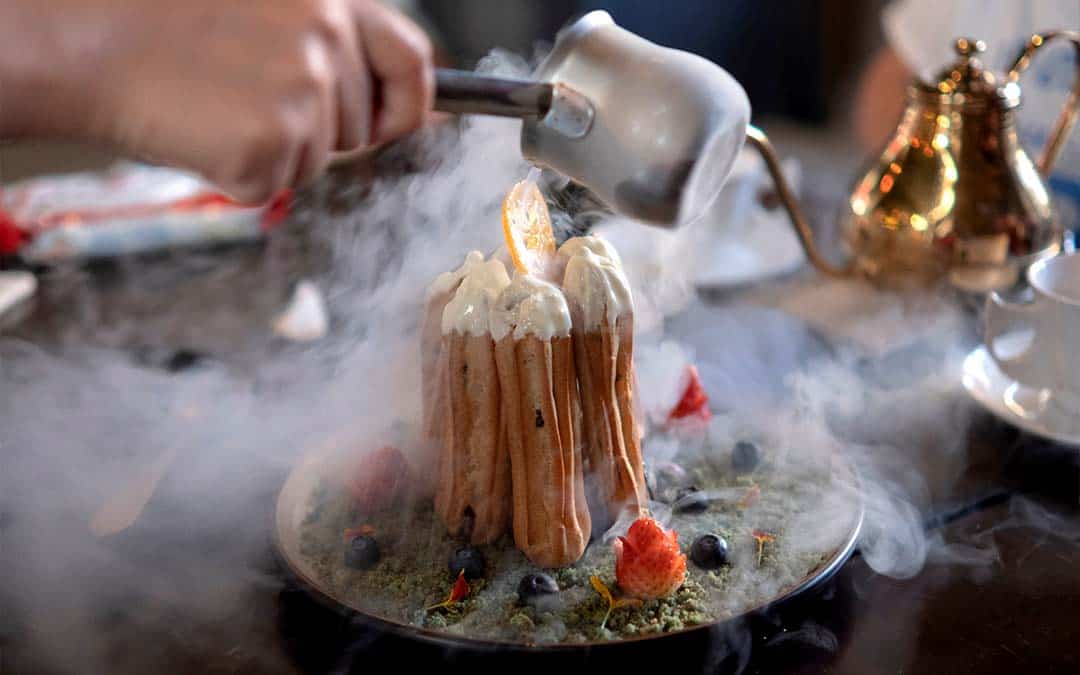
4.5 Vapor and Visual Presentation
When liquid nitrogen evaporates, it produces dense clouds of white vapor. While the vapor itself is harmless, it creates a powerful visual effect.
Chefs use this phenomenon to:
- Enhance presentation
- Introduce dishes with theatrical flair
- Engage sight and smell alongside taste
This visual drama has contributed significantly to the popularity of liquid nitrogen cooking in media and fine dining.
5. Culinary Applications Across Disciplines
5.1 Pastry and Dessert Arts
Pastry chefs were among the earliest adopters of liquid nitrogen due to its precision and ability to stabilize delicate structures.
Common applications include:
- Mousse and foam stabilization
- Frozen fruit inserts
- Rapid chocolate setting
- Multi-textural desserts
Liquid nitrogen allows pastry chefs to push the boundaries of form and texture while maintaining flavor integrity.
5.2 Savory Cuisine and Fine Dining
In savory cooking, liquid nitrogen is often used to preserve freshness, intensify flavors, and achieve precise preparation.
Examples include:
- Freezing herbs for aromatic powders
- Rapid chilling of sauces
- Nitrogen-frozen proteins for ultra-thin slicing
These techniques emphasize purity, refinement, and technical mastery.
5.3 Beverage and Mixology Innovation
Liquid nitrogen has also influenced modern mixology. Bartenders use it to chill drinks instantly, create frozen foams, and add dramatic vapor effects.
Applications include:
- Nitrogen-chilled cocktails
- Frozen alcohol spheres
- Slushy-style drinks without dilution
- Aromatic vapor presentations
When used correctly, liquid nitrogen enhances temperature and texture without altering flavor chemistry.
6. Safety and Professional Handling
6.1 Understanding the Risks
Despite its culinary benefits, liquid nitrogen poses serious risks if mishandled. Direct contact can cause severe cold burns, and excessive nitrogen vapor can displace oxygen in confined spaces.
6.2 Essential Safety Protocols
Professional kitchens follow strict guidelines, including:
- Wearing insulated gloves and eye protection
- Using liquid nitrogen only in well-ventilated areas
- Never sealing it in airtight containers
- Ensuring complete evaporation before serving food
- Storing it in approved Dewar flasks
Proper training and respect for safety are non-negotiable aspects of liquid nitrogen cooking.
7. Cultural and Media Influence
Liquid nitrogen cooking has become a cultural symbol of innovation and modernity. Its visual impact makes it highly attractive for food photography, television, and social media. Cooking shows and online platforms have amplified its popularity, shaping public perception of modern cuisine as experimental, scientific, and theatrical.
At the same time, it has sparked debate about the balance between spectacle and substance, encouraging chefs to use liquid nitrogen thoughtfully rather than as a gimmick.
8. Ethical and Environmental Considerations
Liquid nitrogen itself is derived from atmospheric air and is not inherently harmful to the environment. However, its production requires energy-intensive processes. Responsible use involves minimizing waste, optimizing efficiency, and integrating it into broader sustainable culinary practices.
Ethically, chefs must also ensure that diners are not exposed to risk and that novelty does not overshadow quality, flavor, and nutritional value.
9. The Future of Liquid Nitrogen Cooking
As culinary science continues to advance, liquid nitrogen is likely to remain a specialized but influential tool. Future developments may include:
- Greater energy efficiency in nitrogen production
- Integration with smart kitchen technologies
- Expanded culinary education and training
- More sustainable and controlled usage
Rather than replacing traditional cooking methods, liquid nitrogen will continue to complement them, offering chefs new dimensions of creativity and precision.
Conclusion: Redefining Cuisine Through Cold
Liquid nitrogen cooking represents a profound shift in culinary thinking. By embracing extreme cold as a creative force, chefs have expanded the boundaries of texture, presentation, and sensory experience. More than a technical novelty, liquid nitrogen is a powerful reminder that cooking is both an art and a science.
When used responsibly and skillfully, liquid nitrogen transforms the kitchen into a space of exploration and innovation. As gastronomy continues to evolve, liquid nitrogen cooking stands as a testament to humanity’s ability to reimagine food—not only as nourishment, but as an experience that engages the mind, the senses, and the imagination.