








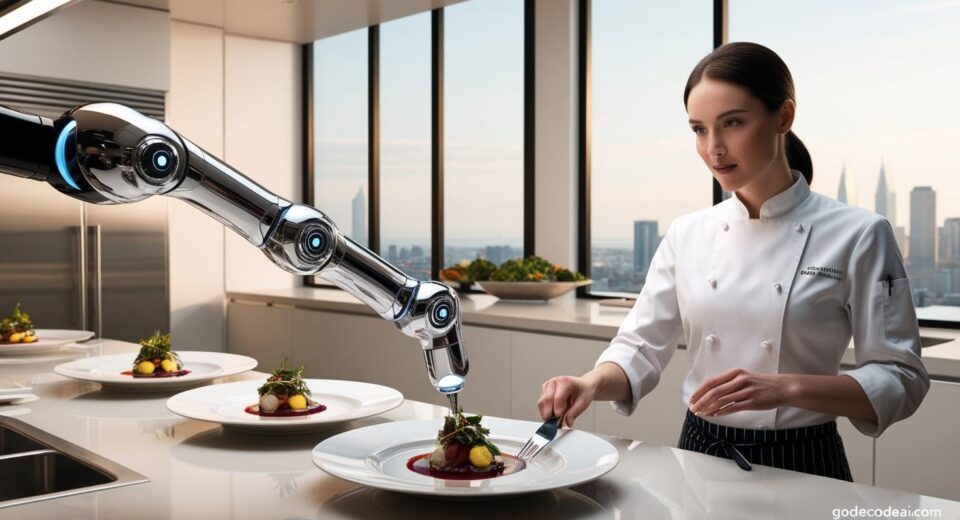

Introduction: From Fear of Automation to a New Culinary Partnership
Few professions are as deeply human as cooking. The kitchen is a place of memory, intuition, craft, and culture—where taste is shaped by experience, and decisions are often made by instinct rather than formula. Yet in recent years, artificial intelligence has entered this traditionally human domain, prompting anxiety and debate. Headlines asking whether “AI will replace chefs” echo similar fears across creative and skilled professions.
This question, however, is fundamentally misguided.
The more meaningful shift underway is not about replacement, but redefinition. Chefs are not being displaced by artificial intelligence; they are increasingly becoming AI co-creators—professionals who collaborate with intelligent systems to expand creativity, precision, efficiency, and sustainability. In this new paradigm, AI functions less as a rival and more as an advanced tool, research partner, and creative catalyst.
This article explores how chefs are evolving into AI co-creators, why this transformation matters for the future of food, and what it reveals about the broader relationship between human expertise and intelligent technology. By examining culinary creativity, kitchen operations, education, ethics, and culture, we will see why the future of gastronomy is not automated, but augmented.
1. The Myth of Replacement: Why Chefs Cannot Be “Automated Away”
1.1 Cooking Is More Than Recipes
At a superficial level, cooking might appear programmable. Recipes list ingredients, measurements, temperatures, and timings—data points that seem ideal for algorithmic control. Indeed, machines can already replicate certain processes with remarkable consistency.
But professional cooking is not merely the execution of instructions. It involves:
- Sensory judgment (taste, aroma, texture, appearance)
- Emotional intelligence (understanding diners’ expectations)
- Cultural knowledge (traditions, taboos, symbolism)
- Improvisation under uncertainty (ingredient variation, equipment failure)
These dimensions are not easily reducible to code. AI can assist, but it cannot inhabit experience in the way a human chef does.
1.2 Creativity Is Contextual, Not Combinational Alone
AI excels at pattern recognition and recombination. It can analyze millions of recipes, flavor pairings, and historical menus to propose novel combinations. Yet culinary creativity is not just about novelty—it is about meaning.
A dish resonates because it connects to:
- A place
- A memory
- A season
- A cultural moment
These layers of significance require human interpretation. AI can suggest possibilities, but chefs decide what matters.
2. From Tool to Partner: Defining the AI Co-Creator Model
2.1 What Does “AI Co-Creation” Mean in the Kitchen?
AI co-creation refers to a collaborative workflow in which:
- AI systems generate insights, options, or simulations
- Chefs provide direction, judgment, and final authorship
- Value emerges from interaction, not delegation
In this model, AI does not replace decision-making; it amplifies it.
Examples include:
- Suggesting unexpected flavor pairings based on chemical compatibility
- Simulating recipe outcomes before physical testing
- Optimizing prep workflows without dictating creative choices
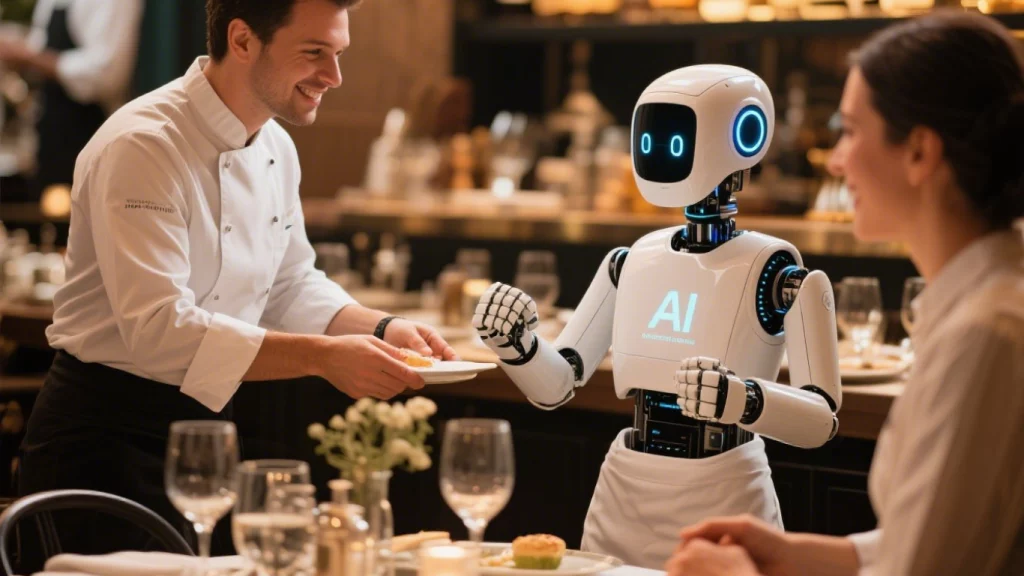
The chef remains the creative lead. AI becomes a powerful sous-chef of the mind.
2.2 Historical Parallels: Technology Has Always Shaped Cuisine
The idea that technology threatens culinary authenticity is not new. Consider:
- The introduction of ovens and temperature control
- The use of refrigeration and vacuum sealing
- The rise of industrial milling and fermentation science
Each innovation initially sparked resistance. Yet over time, they expanded what chefs could achieve. AI represents the next step in this long continuum—not a rupture, but an evolution.
3. How AI Is Already Transforming Culinary Creativity
3.1 Computational Gastronomy and Flavor Science
One of the most exciting areas of AI-chef collaboration is computational gastronomy—the application of data science and machine learning to food.
AI systems can:
- Analyze molecular flavor compounds
- Identify non-obvious but harmonious pairings
- Map regional cuisines by ingredient networks
Chefs use these insights as inspiration rather than instruction. A suggested pairing becomes a starting point for experimentation, refined through human tasting and intuition.
3.2 Recipe Development and Iteration
Developing a new dish traditionally requires multiple physical trials, consuming time and resources. AI can accelerate this process by:
- Simulating variations digitally
- Predicting texture or flavor balance
- Flagging potential issues before cooking begins
This allows chefs to explore more ideas, faster—freeing creative energy rather than constraining it.
3.3 Personal Expression, Not Algorithmic Uniformity
A common fear is that AI will homogenize cuisine. In practice, the opposite is often true. Because AI can handle analysis and repetition, chefs gain more space for personal expression.
Instead of spending hours on trial-and-error, chefs can focus on storytelling, plating, and emotional impact—areas where individuality thrives.
4. Operational Intelligence: AI Beyond Creativity
While creativity attracts the spotlight, AI’s role in kitchen operations is equally transformative.
4.1 Efficiency Without Dehumanization
Professional kitchens are notoriously stressful environments. AI systems can help by:
- Forecasting demand more accurately
- Reducing food waste through smarter inventory management
- Optimizing staffing schedules
These improvements do not diminish the chef’s role; they improve working conditions and sustainability, allowing chefs to focus on cooking rather than firefighting.
4.2 Consistency as a Creative Foundation
Consistency is often misunderstood as the enemy of creativity. In reality, it is its foundation. AI-assisted monitoring of temperature, timing, and processes ensures reliability—especially in large or multi-location operations.
With consistency handled by systems, chefs can innovate with confidence, knowing the basics are secure.
5. The Chef’s Evolving Skill Set in the Age of AI
5.1 From Manual Mastery to Cognitive Leadership
The rise of AI does not reduce the importance of skill—it reshapes it. Future chefs will still need:
- Sensory excellence
- Technical competence
- Cultural literacy
But they will also require:
- Data literacy
- Systems thinking
- Collaborative mindset
Understanding how to question, guide, and interpret AI outputs becomes a new form of culinary intelligence.
5.2 The Chef as Curator and Editor
In an AI co-creative model, chefs increasingly act as:
- Curators of possibilities
- Editors of machine-generated options
- Ethical and aesthetic gatekeepers
The value lies not in generating more ideas, but in choosing the right ones.
6. Culinary Education: Training Chefs to Work With AI
6.1 Integrating Technology Without Losing Craft
Culinary schools face a critical challenge: how to teach AI tools without eroding foundational skills. The answer is not substitution, but integration.
Students must:
- Learn classical techniques and sensory evaluation
- Understand food science and cultural history
- Use AI as a supplement to experimentation, not a shortcut
Hands-on cooking remains irreplaceable. AI becomes a lens, not a crutch.
6.2 Teaching Critical Thinking Over Tool Dependency
As AI tools proliferate, the key educational focus shifts to critical thinking:
- When should AI be trusted?
- When should it be challenged?
- How do biases enter datasets and recommendations?
Chefs trained this way become resilient professionals, not passive users of technology.
7. Ethics, Authenticity, and Cultural Responsibility
7.1 Who Owns a Dish in AI Co-Creation?
As AI contributes to idea generation, questions of authorship arise. The prevailing consensus in professional kitchens is clear: AI does not replace human authorship.
AI provides inputs, but:
- Chefs define intent
- Chefs make final decisions
- Chefs are accountable for outcomes
Authorship remains human, rooted in responsibility and reputation.
7.2 Protecting Culinary Heritage
AI systems trained on global datasets risk flattening cultural distinctions if used carelessly. Responsible chefs act as cultural stewards, ensuring that:
- Traditional cuisines are respected, not extracted
- Context is preserved alongside technique
- Innovation does not erase identity
Here, the chef’s role as cultural guardian becomes even more important.
8. Case Examples: Chefs Working as AI Co-Creators
8.1 Experimental Kitchens and R&D Labs
In high-end restaurants and food innovation labs, chefs already use AI to:
- Explore future food concepts
- Design plant-based alternatives
- Reduce environmental impact
These environments demonstrate AI’s strength as a research collaborator rather than a frontline cook.
8.2 Everyday Professional Kitchens
Even outside elite spaces, AI assists with:
- Menu engineering based on customer preferences
- Waste reduction strategies
- Supply chain transparency
The result is not fewer chefs, but more effective ones.
9. The Psychological Shift: From Threat to Empowerment
Perhaps the most significant transformation is psychological. When chefs stop viewing AI as a threat, they begin to see it as:
- A safety net
- A creative mirror
- A source of challenge and inspiration
This mindset shift unlocks experimentation and confidence, reinforcing the chef’s identity rather than undermining it.
10. The Future Kitchen: Human at the Center, AI at the Side
Looking ahead, the most successful kitchens will not be the most automated, but the most human-centered.
In these kitchens:
- AI handles complexity, prediction, and repetition
- Humans handle taste, meaning, and connection
- Collaboration replaces control
The kitchen becomes a space where technology serves humanity, not the other way around.
Conclusion: Why Chefs as AI Co-Creators Are the Real Future
The narrative of replacement is rooted in fear, not reality. Cooking, at its highest level, is an expression of humanity—of care, culture, and creativity. Artificial intelligence, powerful as it is, does not diminish this truth. Instead, it offers chefs new ways to explore it.
By becoming AI co-creators, chefs expand their reach without surrendering their soul. They gain tools that sharpen intuition, accelerate learning, and open creative doors—while remaining the authors of flavor and experience.
The future of gastronomy will not be written by algorithms alone, nor by humans working in isolation. It will be shaped in the space between them—where data meets instinct, and where chefs, empowered rather than replaced, continue to define what food means in an intelligent age.